Allergy Free Gardening

Allergy-Free New York - New York Times
Too Much Pollen? Blame the Males - All Things Considered
Safe Sex in the Garden - Weekend Edition

If you are suffering from allergies, tree and plant pollen may be the reason.

|
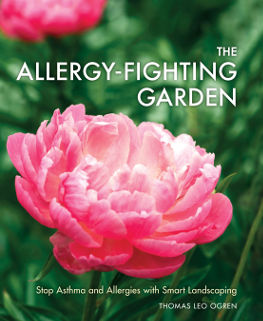
NEW book, The Allergy-Fighting Garden, by Thomas Ogren! Buy it from one of these online retailers: Amazon | Barnes & Noble | IndieBound | GoogleBooks | iBooks Two roads diverged in a wood, and I- In the video to the right, this will give you an idea of what one single highly allergenic tree can do for the air quality immediately around it. Also note, that as the pollen moves away from the tree, it initially goes up, but within two dozen feet or less it quickly start to sink, and much of it will fall out and land on anything within 50-60 feet of the tree itself. Imagine if this kind of tree was planted and growing in your own yard? Your entire yard would be covered in highly allergenic pollen. Imagine if a tree or shrubs like this were planted right under your bedroom window? What if they were planted close to your front door? What if they were planted at the very school where your young children attend? (As they all -too often are.) Almost all junipers (often called "cedars") are separate-sexed (dioecious) and each one will be either a male plant, or a female. The female junipers produce juniper berries but NO pollen. The males always produce pollen. For some very dumb reason, modern horticulture has propagated and sold hundreds of millions of male juniper trees and shrubs. In city after city almost all the juniper bushes planted are now male clones. All of them, like the male tree in this video, all of them will release huge amounts of allergenic pollen each year. Often they will bloom twice, in spring and fall, and will shed pollen each time. These male junipers are a serious health hazard and nurseries should not be allowed to sell them. (In Albuquerque, NM sale or planting of these is now banned per their city Pollen Control Ordinance.) March 3, 2014 KCRA Tom Ogren - Allergy-Free Garden 12-5-2012 from Mike Carroll on Vimeo. Listen to the Mike Nowak Podcast featuring Tom Ogren From May 7, 2012. In spring of 2012 Tom Ogren was hired by Johnson & Johnson (and their Canadian allergy med, Reactine) to do a coast-to-coast allergy audit of the 11 largest cities, from Vancouver to Halifax. He drove some 12,000 miles in his old truck, in each city looking carefully at the landscapes in residential areas, in commercial areas, downtown, and at elementary schools. In each city he also visited local nurseries to see exactly which plants were being sold, and how allergy-friendly (or not) they were. What he found surprised even him...please do get a look at The PolleNation Report. He also did this video for Reactine, since they were sponsoring the big allergy audit. Tom is not at all opposed to people using various allergy medicines when they're needed. Likewise he always advises that people see an allergist if at all possible. But, the bottom line is this: the best allergy study focuses on avoidance; avoid as much as possible the things that trigger your allergies. The place to start is always with your own city, and your own front and back yards. Make them as allergy-free as you can, and you and your family will be healthier for it. We post this video, not in particular to plug Reactine (even though it does work well), but simply to let folks get a chance to know Tom a little better. Gardening with Allergies Just because you have allergies shouldn't mean that you can't have a great garden, and one that is sneeze-free. This website is devoted to helping people with allergies and asthma create gardens that won't make them sick. For those gardeners and designers who are lucky enough not to have allergies, creating gardens and landscapes that are allergy-friendly is always the kind, considerate thing to do. There's plenty of the best advice here on just how to do it. Welcome to Allergy-Free Gardening! Greetings! Thanks for coming to visit. This website has been up for a dozen years now, and we’ve met a great many very wonderful people through it. If you're new to all of this, here’s how this site was born: A brief History of Allergy Free Gardening Some twenty-five years ago horticulturist Tom Ogren became very interested in allergenic pollen from landscape plants because his wife, Yvonne, had severe allergies and asthma. Tom was teaching horticulture and one day asked his students to do some "sniff tests" with him. They sniffed pansies, double dianthus and petunias and nothing happened, but when they tried bottlebrush flowers people started sneezing, hard. In later weeks they experimented with a great many more types of flowers. What they soon discovered was that certain flowers never made anyone sneeze, that some flowers made a only a few students sneeze, and that there were others that almost always caused trouble. Eventually the sniff tests were stopped because several people got dangerously ill from them. By this time though, Tom was hooked on the idea that the right gardens wouldn't trigger any allergies. He next started testing plants to see if they would cause any odd skin reactions, and again found plenty that did, and others that never did. He tried to buy books on allergy free gardening, but in those days there was nothing to buy; there were no such books to be had. He kept on researching the subject, eventually building up a very large body of plant/allergy data that no one else had. In the following years Tom went back to college and earned an MS degree, focusing all of his graduate work on plant/allergy connections, and on the different plant flowering systems. One thing that deeply interested him was that so many separate-sexed (dioecious) trees and shrubs often triggered severe allergies. Occasionally he’d come across advice from lung associations or allergy groups that suggested no one plant any of these trees or shrubs (these included plants such as yew, yew pines, willows, ash, mulberry, Pistache, pepper trees, junipers, maples, box elders, poplars, aspens, etc.). Eventually it occurred to him that since so many of these "very worst" plants were dioecious, separate-sexed, where one tree would be all male, and another all female, that in truth only the males produced pollen. He also concluded that since female plants never produced any pollen, that they were the ones that would be most truly allergy-free. He was the first to notice and then write and publish about how the sex of plants influenced pollen allergies. After some years of research Tom started to photograph flowers of suspect trees and shrubs. Rather suddenly he discovered that although it was easy to find plenty of males to photograph, female landscape plants were surprisingly rare. He found this same situation in city after city. This important discovery, now termed “botanical sexism” in scholarly journals, exists worldwide in most modern landscapes. Eventually he came to realize that in the name of tidiness, for the cause of low maintenance, male trees and shrubs were being planted by the millions. Since males produced no seeds, fruits, messy flowers or old seedpods, they were considered far superior to female plants. That these same male plants would plague urban areas with huge amounts of allergenic pollen never seems to have been considered. But of course, this is exactly what has happened. Tom Ogren’s book on the interactions of plants and human health, Safe Sex in the Garden, gets its name from this peculiar, unnatural, unhealthy situation in our urban landscapes. At one point Tom started to measure pollen from different landscape plants, to see how far it would travel. He’d place greased microscope slides at 50 foot intervals away from a pollinating tree and then measure how much he was trapping. In all instances he found that the closer the slides were to the source, the more pollen they trapped. From this early pollen dispersal work and subsequent writings about it came the term “proximity pollinosis,” as it is now called in scientific journals devoted to pollen and allergy. Along the way Tom sought and received much valuable advice and help from many allergists, botanists, aero biologists, health researchers, urban foresters, nursery people and arboretum faculty. Often writing under his full name, Thomas Leo Ogren, his work attracted media attention far and wide. His books have been favorably reviewed in the London Times, the Jerusalem Post, The New Scientist, in Der Spiegel, in hundreds of other publications. His research was the focus of a CBS Evening News special; the Canadian Discovery Channel filmed a documentary about his discoveries; he has appeared on the BBC, the CBC, on All Things Considered, and Linda Wertheimer interviewed him on NPR's Weekend Edition. In New Zealand the city councils of both Christchurch and Auckland were becoming increasingly worried about the large increases in urban allergies. New Zealand arborist societies brought Tom to New Zealand to personally inspect their city landscapes for pollen-allergy potential. While in New Zealand he discovered that they, too, had almost the exact same kind of landscape problems found in American cities....too many male cloned plants. As a result of the five weeks he spent there, major cities in NZ are now adopting allergy-free planting principles. Tom has spoken to numerous groups of allergists and other MD's and has been well received. At the Chelsea Garden Show in England a university did an award-winning display of pollen-free plants based on allergy free gardening. The USDA urban foresters used the OPALS (see) scale to form allergy predictions for different cities, the State of California endorsed allergy free landscapes in their most recent Asthma Initiative, and the American Lung Association in Richmond, Virginia installed an allergy-free landscape for their new headquarters. The Future of Allergy-Free Gardening Most recently, much increased energy and focus is going into the Allergy Free School Yard Initiative, first started in Canada by horticulturist Peter Prakke. Many, if not most, school yards were landscaped so that they are especially allergenic. However, worldwide, school districts are starting to assess their own school yards, and a growing number are signing up to use only allergy-free plants in all future landscaping. It is quite possible now to produce fine gardens and landscapes that do not trigger any allergies. Unfortunately, the opposite, high allergy plants, that's what most often is still being planted. And every day people with allergies suffer needlessly. Asthma is now the number one chronic childhood disease. School after school is still landscaped with the most allergenic plants possible. And yet thousands of people have now changed their own yards. They have gotten rid of the worst plants and replaced them with pollen-free ones. Many people write to tell us how this has changed their life, and all for the better. But there is so much more to be done. People with allergies and asthma deserve clean air to breath. Kids deserve schools that are not covered in pollen. Everyone deserves city landscapes that are healthy places to live and work. We need your help; we need concerned citizens to send emails, write letters to their newspaper editors, and make phone calls to their own city council members. We need help to get cities to stop planting any more male cloned trees. We need help to get school districts to clean up their school yards. We need your help to educate the public. Your help is needed to get more cities to enact and enforce pollen control ordinances. Your help is necessary to get more colleges and universities to start teaching allergy-free best practices in their landscape design classes, their urban forestry studies, in all of the horticulture classes. Yes, there’s still so much to be done, but real progress has been made, and with your help, we will make a difference. Again, welcome to Allergy-Free Gardening. Please keep in touch! |